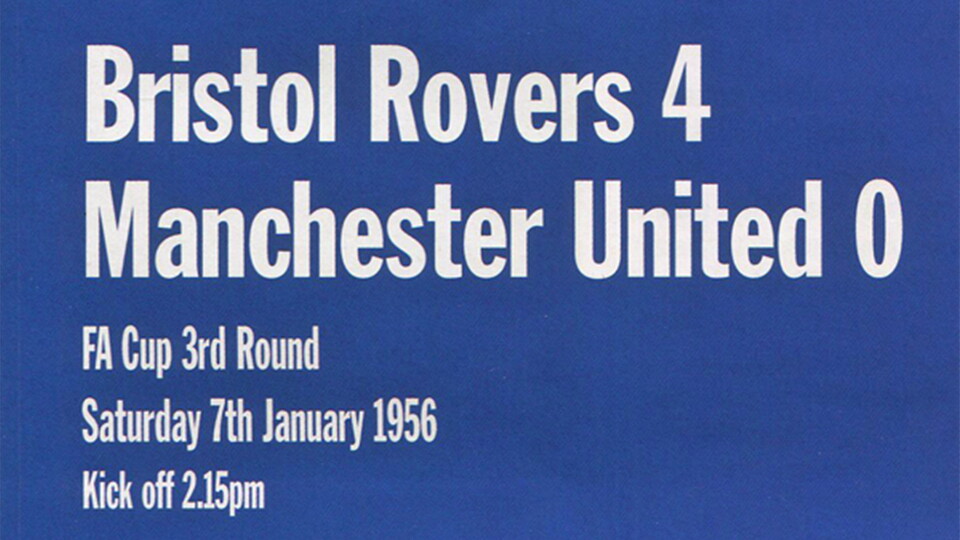
Just two lines from Tote End Boys, the Rovers anthem written by the late Ben Gunstone, and while younger Bristol Rovers supporters may not appreciate the significance of the date, it’s the anniversary of a famous Rovers victory over Manchester United, the team known at that time as the Busby Babes.
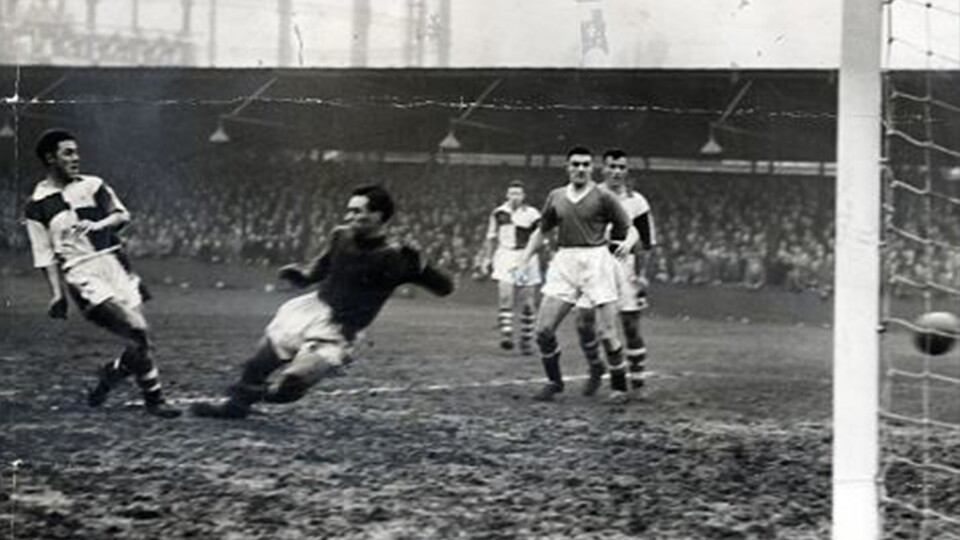
Seventy years ago today, Bristol Rovers, then playing in the Second Division of the Football League (now the Championship), played Manchester United of the First Division (now the Premier League) in a Third Round FA Cup tie at Eastville in front of a crowd of 35,872.
Rovers were 4-0 winners that day, and the scorers were, if you haven’t already guessed, Bradford, Meyer and Biggs, though not in that order!
Rovers took the lead after ten minutes when a cross by Meyer struck a United defender and fell to Biggs, who curled a right-footed shot past goalkeeper Wood.
The visitors did get the ball in the Rovers net, from a Pegg free kick, but because it had been an indirect free kick and no other player touched the ball on its way into the goal, the effort was ruled out.
Rovers scored a second goal thirty seconds before half-time when Meyer collected a cross from Petherbridge, whose initial shot was blocked. However, the ball rebounded to him, and he made no mistake with his second attempt, from six yards out.
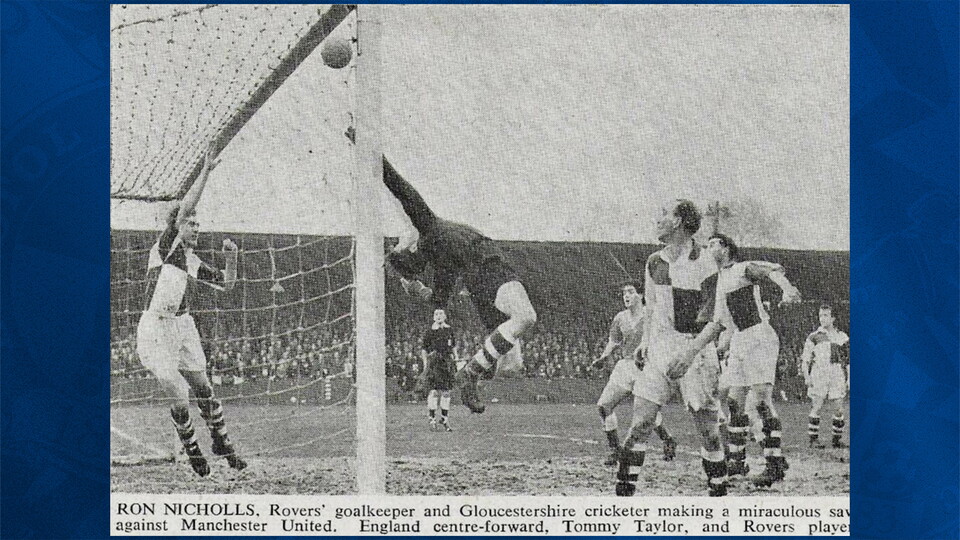
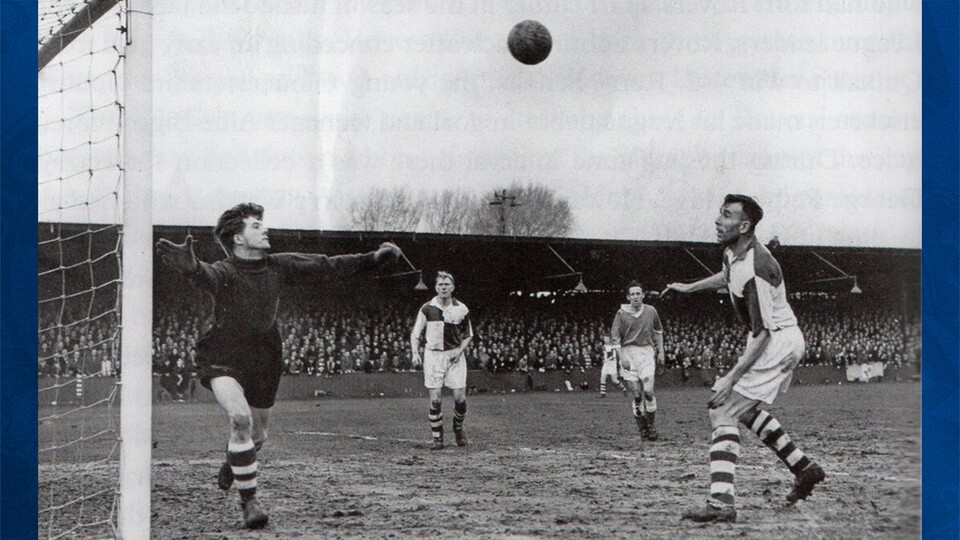
Goalkeeper Nicholls twice saved well after the break, gathering a header from Colman and then punching a cross from Pegg just when it seemed as though Taylor would beat him to it and head home.
Rovers increased their lead on 62 minutes when a cross from Bradford reached Biggs, who steadied himself before beating Wood with a shot from 15 yards.
Wood made a number of saves to prevent further Rovers goals, but he was beaten again from the penalty spot, after a Bradford header had been punched away by Byrne and the Rovers forward, capped by England the previous October, made no mistake with his spot kick.
This is how the teams lined up on that famous (for Rovers!) occasion.
Rovers: Ron Nicholls, Harry Bamford, Frank Allcock, Jack Pitt, Paddy Hale, Peter Sampson, George Petherbridge, Alfie Biggs, Geoff Bradford, Barrie Meyer, Peter Hooper
Manchester United: Ray Wood, Bill Foulkes, Roger Byrne, Eddie Colman, Mark Jones, Jeff Whitefoot, Johnny Berry, John Doherty, Tommy Taylor, Dennis Viollet, David Pegg
It was a famous victory for Rovers, and Bert Tann’s side received many plaudits for their display. I particularly liked some of these comments, contained in one newspaper report.
‘This was a slaughter. Manchester United, leaders of the First Division, reeled off the field at Bristol yesterday after one of the worst drubbings in their history. There were no excuses. The score against the visiting aristocrats could have been six goals. Seldom have I seen a top quality side so disorganised and so demoralised.’
‘For me, the personality of this toughest Cup tie was leggy 19-year-old local boy Alfie Biggs. A Royal Army Ordnance Lance Corporal, stationed at Corsham, shocked Busby’s boys and strode through the mud like a young giant.’
Both managers also had their say afterwards with Rovers boss Bert Tann saying, ‘We are all extremely pleased with the boys for doing do wonderfully well.’
His United counterpart, Busby, said, ‘We have no excuses to offer. I congratulate Bristol Rovers on their fine win.’
Biggs, the scorer of two goals that afternoon, said this on the 50th anniversary of the match: ‘United were a little complacent, but they were parading all their stars except Duncan Edwards and, in sporting terms, it was the shock to end all shocks. I scored a couple of goals and look back on that achievement as the pinnacle of my life in the game.’
At the end of the 1955/56 season, Rovers finished in sixth place in the Second Division, with 48 points, seven fewer than champions Sheffield Wednesday, four fewer than runners-up Leeds United and on the same number of points as Liverpool, Blackburn Rovers and Leicester City. Had Rovers beaten Leeds in their penultimate game, they would have required one point from their final game of the campaign, against Liverpool, to gain promotion to the top flight – they lost both games, though, by the same 2-1 scoreline.
Manchester United finished the campaign as First Division Champions, 11 points clear of second-placed Blackpool and retained their title at the end of the 1956/57 season, eight points ahead of runners-up Tottenham Hotspur.
Manager Matt Busby had built a side that looked as though they would dominate English football for years to come and go on to become Champions of Europe. However, it was whilst returning home from a European Cup tie in Belgrade, on February 6 1958, that tragedy struck.
The chartered aircraft carrying the team back to England needed to stop at Munich to refuel, in blizzard conditions. Snow and slush covered the runway. After fuel had been taken on board, there were two aborted attempts to continue the journey back to England. A third attempt was made, and the aircraft failed to lift off, overshot the runway, went through a fence, and one of the wings clipped a house.
Seven United players died instantly, including five who had played against Rovers two years before, namely Byrne, Colman, Jones, Pegg and Taylor, while Berry’s injuries were such that he never played again.
And so, when you hear these words again, probably the next time you walk out of the Memorial Stadium, you will know what these words mean to Bristol Rovers supporters.
Bradford, Meyer, Biggs,
The 7th of January 1956.
Words by Keith Brookman